Habit loops and weed.
After years of using weed, it can feel automatic. Something happens, and before you have time to think, you are already reaching for it.
This is not a lack of willpower. It is a habit loop. Understanding this makes cutting down feel less personal and more manageable.
What a habit loop is
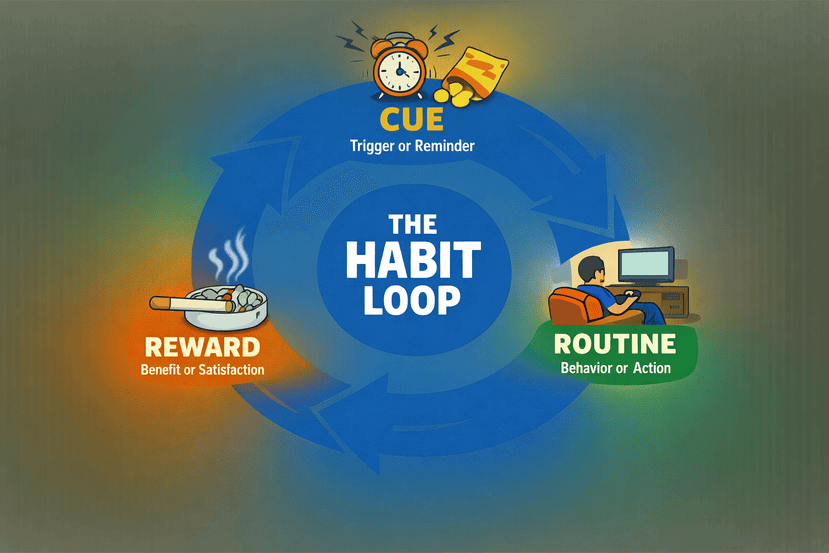
A habit loop has three parts. A trigger, a behaviour, and a reward.
- A trigger starts the loop.
- The behaviour follows automatically.
- The reward reinforces it.
With long-term cannabis use, this loop can run quietly in the background for years.
How weed fits into habit loops
Weed often becomes the fastest way to change how you feel. Stress, boredom, tiredness or discomfort trigger the urge. Smoking provides relief.
The brain learns this quickly. Over time, the loop fires before you even notice the trigger.
This explains why urges often appear during evenings, after work, or in quiet moments.
Why Old Habits Are So Hard to Shift After Years of Use
The Deep Grooves of a Long-Term Habit
The longer a habit loop runs, the deeper it settles. It’s simple physics, really. In the early days, a new routine is like a faint path through the woods—you have to think about every step. But after five or ten years? That path has been paved into a six-lane motorway.
This happens because of something called long-term potentiation. Basically, your brain is a fan of efficiency. Every time you repeat an action, the physical connection between your neurons gets stronger and faster. You aren’t just “choosing” to do something anymore; you’ve literally wired your brain to do it on autopilot.
You’re Retraining a System, Not Just “Trying Harder”
This is exactly why cutting back after a long time feels like such a slog. You aren’t just fighting a one-off craving; you’re trying to reprogram your entire operating system.
Think of it like this: your logical brain (the prefrontal cortex) gets tired easily. It’s like a battery that drains by 4 PM. But your habit centre (the basal ganglia) is like a generator that never switches off. After years of reinforcement, the habit centre takes the wheel before your conscious mind has even had its morning brew. It’s not a lack of willpower; it’s just how you’re built.
The Anchors: Boredom and Stress
These old loops don’t just pop up for no reason. They’re usually tied to how we’re feeling in the moment. Over the years, your brain has learned that when things get uncomfortable, “this habit” is the quickest way to feel better.
- Boredom Triggers: When your mind is under-stimulated, it’ll naturally default to the loudest, easiest path it knows. You can check out how to handle these boredom triggers here to stop the autopilot from kicking in.
- Stress Triggers: When you’re stressed, your “smart” brain goes offline, and your “habit” brain takes over for safety. Spotting your stress triggers is the secret to making sure you don’t slide back into the old ways when things get heavy.
Why willpower is not enough
Willpower works best for short decisions. Habit loops operate below conscious thought.
By the time you try to use willpower, the loop is already running.
This is why changing the routine around the habit matters more than fighting the urge directly.
How to Interrupt a Habit Loop
To break a habit, you have to stop treating it as a single event and start seeing it as a predictable sequence. Most people fail because they try to fight the urge with willpower alone, rather than disrupting the mechanics of the loop.
The habit loop consists of three parts: the Cue (the trigger), the Routine (the behavior), and the Reward (the relief or dopamine hit). To change the outcome, you must intervene before the loop completes.
- Notice the trigger, not just the urge: Habits are tied to specific times, places, or emotional states. Instead of fighting the urge to snack, notice that the trigger is actually “sitting on the sofa at 8 PM.” Identifying the cue allows you to anticipate the loop before it gains momentum.
- Change the environment when the loop starts: Your environment is full of invisible “hooks.” If you’re trying to stop scrolling on your phone, move the charger to a different room. By adding physical friction to the trigger, you break the automated nature of the response.
- Delay the behaviour rather than blocking it: Total suppression often leads to a “rebound” where the craving gets stronger. Try a 10-minute rule: tell yourself you can give in to the habit, but only after 10 minutes of waiting. This gap allows your rational brain to catch up to your impulses.
- Swap the action, not the reward: You rarely get rid of a craving, but you can change how you satisfy it. If you browse social media for a “brain break” (the reward), swap the scrolling for a 2-minute walk. You get the same rest, but through a healthier routine.
- Repeat this calmly, not perfectly: Habit loops are neural pathways that have been reinforced over years. If you slip up, don’t spiral into guilt. Every time you successfully interrupt the loop, you are physically weakening the old connection and strengthening a new one.
This works best alongside mental reset tools, which help lower your baseline stress and make these interruptions much easier to execute when an urge strikes.
Habit loops and progress
Habit loops weaken through repetition, not force. Each time you interrupt the loop, even briefly, you change it.
Progress often shows up as urges arriving later, feeling weaker, or passing more quickly.
This is why change can feel slow, but still be working.